Participants join our simulated business analyst work experience course around the world for 8 weeks, throughout the year, to work in teams. Successfully completing this business analyst course within the stipulated time will ensure that you can demonstrate your competence as a business analyst and meet real world expectations. This work experience offers you a professional business analyst certification that is greatly valued by hiring managers.
When you join Savio Global in this simulation of a Business Analyst, you are joining a firm that will challenge you and ensure your professional development. In this role you will work on the best teams to solve difficult business problems and perform professional business analysis. You will also work with many experts, from data scientists and researchers to software and app designers. This program is a 100% experiential learning program that readies you for a career as a business analyst.
Your Business Analyst Certification and Work Experience
You’ll work in teams of typically 3 – 5 consultants, playing an active role in all aspects of the business engagement.
In this Business Analyst course, you will perform business analysis, which includes gathering and analyzing information, formulating and testing hypotheses, performing benchmarking, business data analysis and developing and communicating recommendations. You’ll also have the opportunity to present results to management and implement recommendations in collaboration with team members.
You will work from home with your Savio Global colleagues, owning a distinct piece of the project. Some examples of the specific work may include interviewing people, leading teams, building business and technological models, creating and delivering presentations, and working with Savio Global subject experts to develop perspectives and insights.
Our Business Analyst Work Experience program gives participants first-hand and immersive experiences. Through this simulation course, you will participate in continuous training, as well as a range of continuous learning activities to get to know your work leading up to your professional business analyst certification.
Business Analyst Training – Be the best in business analysis
You’ll gain new skills and build on the strengths you may already have. You as a Business Analyst will receive exceptional training as well as frequent coaching and mentoring from colleagues on your teams. This support includes daily training. Moreover, to ensure that you are a truly certified business analysis professional, an expert from our practice is assigned to you to help guide you throughout your work experience.
Through one month of mentor guided work experiences in business analysis, you will learn, grow and be evaluated in the abilities to:
create professional requirements documentations using prioritization techniques, user stories, and more!
use advanced business modelling notations for communication
apply advanced SQL for database querying
use MS Excel for dashboarding
develop tests for product verification
use Tableau to create and present stunning visualizations
develop insights from data and guide business decision making
communicate professionally
Includes over 25 hours of instructional videos for FREE! Placement assistance included. Know more here.
This low cost, high value Business Analyst Work Experience provides you a business analyst certification and prepares you and enhances your skills to secure a job as a business analyst. Explore thousands of Business Analysis Jobs (Credly: External Site).
Learn business analysis from Master Facilitator and Professor, Savio Saldanha, PMP
Prof. Savio Saldanha will mentor you in this business analyst certification program. Learn from the best; be the best!
Savio is an industry professional and veteran project manager. He has served in several techno-functional roles at companies including Dentsu International, Bank of America, CITI Bank, TCS and L&T Infotech. He is recognized by LinkedIn as being among the top 5% in AI ML globally. He also serves as an Advisor to Harvard Business Review Council, USA and is a Contributing Member to the Python Software Foundation, USA. Savio has authored two books on project management and business analysis and is a Contributing Author to the Project Management Standard Seventh Edition 2021, PMI USA. He is a Certified Project Management Instructor and Professional, Software Quality Assurance Specialist, (ISTQB Belgium) among others. He currently also serves as Adjunct Professor for Analytics and Project Management at Universal Business School, Mumbai.
Business Analyst program reviews by participants
Business analyst salaries in the US
The average base salary a Business Analyst makes in the United States ranges between $82,411 and $93,000. (Data: Indeed and BLS). The average additional cash compensation for a Business Analyst in US is $7,869. The average total compensation for a Business Analyst in US is $90,742. To know details of business analyst salaries in every state in the USA, read here.
Who is this business analyst certification for – Beginners or Experienced Professionals?
Our Business Analyst certification program is designed to cater to beginners, freshers as well as experienced professionals. Because of the depth of the program, the ideal candidate is one who is willing to invest the effort to complete the projects, tasks, and stakeholder presentations, within a timely manner. Our team of educators are constantly evaluating you on key business analyst skills like critical thinking, analytical reasoning, communication abilities, and many more in order to develop and enhance you.
Frequently asked questions about business analyst training and certification with work experiences
What are the eligibility criteria for this Post Graduate Program in Business Analysis with Immersive Experiences?
For admission to our Work Experience Program in Business Analysis, candidates should have a bachelor’s / master’s degree in any discipline with an average of 50% or higher marks.
Can candidates from non programming backgrounds apply?
Yes. The program develops skills in business analysis. Business analysts are semi-technical roles, that do not emphasize programming. However, our program includes building skills in SQL, which we begin from the basics.
Can freshers or beginners join the program, those without work experience?
The program is designed for freshers / beginners as well as working professionals.
What can I expect from this program?
In addition to experiencing the role of a business analyst yourself, you also gain: – Gain the necessary skills to secure your business analyst job – Be ready to crack your next business analyst interview – Gain an industry recognized certificate from Savio Global – Lifetime access to all program elearning content – Lifetime career coaching, guidance, and placement assistance
What are the placement assistance options I get?
Savio Global’s Job Assist program is a country-specific offering to help you land your dream job. With the Job Assist program, we offer extended support for the certified learners who are looking for a job switch or starting with their first job. Upon successful completion of this immersive and experiential business analyst program, you will be eligible to apply for Job Assist and your details will be shared with our network of recruiters and hiring managers. As a part of this program, we offer the following exclusive services: – Resume building assistance – Career Mentoring and Interview Preparation sessions
Will I get live coaching and mentoring to be a business analyst?
Yes, you will receive regular business analysis mentoring and coaching from senior industry professions and leaders twice every week for the duration of the program. Industry veterans include VPs, directors, and professionals in the field of business analysis.
What qualifications do you need to be a business analyst?
– A graduate / post graduate degree – Relaxed education qualifications in some companies – High school diploma – the ability to use your initiative – the ability to work well with others – good verbal communication skills
Can fresher join as business analyst?
Usually, business analysts come from engineering or business (MBA) backgrounds. For a complete fresher / recent graduate without any work experience, the only way to enter a career as a business analyst is by undertaking the Business Analyst Work Experience Program offered by Savio Global. Such a program helps fill gaps in your experience, offers new and real-world experiences, and prepares you for the workplace.
Is business analyst easy to learn?
Business analysis is a career with much variety, demanding skills such as problem solving, relationship management, time management and good communication. It can be very satisfying for those with the inclination to pursue it and the diversity it offers.
How do I start a business analyst career?
– Learn business analysis fundamentals. – Take a business analysis work experience program. – Work on projects to develop your practical business analysis skills. – Develop visualizations and practice presenting them. – Develop a Business Analyst portfolio to showcase your work. – Get familiar with important software used in business analysis. – Familiarize yourself with glossaries around business analysis.
It is completely possible for a non-IT / non engineering professional to become a business analyst. Many of our program participants did not have engineering backgrounds and have been hired in the roles of business analysis. Read reviews here.
While different industries require industry specific skills, our research shows that most business analyst jobs vacancies tend to require a common set of competencies. The following is our compilation of the typical job description of a business analyst profile.
Bachelor’s Degree or related experience (preferred in IT, technology, business, marketing, or a industry related field).
0-5 years’ experience.
Data visualization (Tableau / Power BI) & SQL skills and experience.
Advanced MS Excel skills including formulas, pivot tables, data filters/sorts.
Works collaboratively with stakeholders and business leaders to understand, review, analyze and evaluate business needs.
Responsible for business requirements: definition and documentation for new and changed application deliverables.
Act as a liaison between business partners and IT development team.
Self-motivated, willing to learn new technologies and able to work independently & cross-functionally
Goal-oriented, passionate, high-energy professional with a “no excuses” attitude
Excellent oral and written communication skills
Must be comfortable and competent in communications with senior stakeholders both internally & externally
Possesses the drive to participate and succeed in the growth of the company
Strong computer skills with experience using MS Office, and Google applications
Our Business Analyst Work Experiences help students and candidates master these specific skills needed to succeed in interviews and jobs as business analysts.
These critical skills are also useful in a wide variety of allied job roles as well including Data Analyst, Project Manager, Financial Analyst, Data Scientist, and many more. Read more about related roles here.
Business analysts and data analysts share many responsibilities. But there are some key differences between them, too. Discover what the role of the business analyst and data analyst are, and how to decide which role might suit you best. To maintain a competitive edge, organizations rely ever more on data insights. This is either to solve existing problems or to identify new ones. Two common data roles you may come across are business analysts and data analysts. However, the many similarities between these roles can cause confusion when trying to distinguish between them.
In today’s world, data and technology increasingly pervades every industry and every aspect of how a business is run. This makes a career in data and technology a compelling prospect for many, with a variety of exciting career paths to choose from.
In this post, we’ll explore the differences between data analysts and business analysts. We’ll look at their responsibilities, how much they earn, and offer some tips for deciding which career path to take. We’ll cover:
What are the different responsibilities for business analysts and data analysts?
Should you become a data analyst or a business analyst?
Key takeaways
1. Business analysts vs. data analysts: What is the difference?
Before digging into the differences between business analytics and data analytics, it’s important to understand that they share many skills. For this reason, the terms are often used interchangeably and the responsibilities between them can be quite fluid. However, the core differences between data analysts and business analysts are threefold:
What value each role brings to the organization
The stakeholders they work with
The skills required to succeed in the role
Let’s explore further.
What do business analysts do?
Business analysts help identify problems, opportunities, and solutions for their organizations.
A business analyst is someone who focuses on an organization’s business operations. While they work with data, their main aim is to help find solutions to known business issues. For instance, how to improve products, services, internal processes, or financial reporting. While business analysts need to understand and apply aspects of the data analytics process, this is a means to an end, rather than an end in itself. In short: data guides them, but profit drives them.
Business analysts are practical problem-solvers. They take a high-level view of what’s needed to make a business run more effectively. They’re strategic-minded and commercially focused. Business analysts need technical expertise, but their most invaluable traits are communication and leadership skills. In many ways, business analysts are not just problem-solvers, but salespeople. They must work with executive directors, board members, and other key decision-makers to get buy-in for their ideas. Having excellent powers of persuasion is vital for a business analyst. They must frame solutions in a way that convinces senior management that their chosen path is the right one for the business.
It can help to think of a business as a cruise ship. A business analyst would be the ship’s navigator. While they don’t make the final decision about the ship’s route (that’s up to the captain and other senior staff) they do have a better understanding than most of the ship’s quirks and nearby ocean topography (or the business landscape). As the most knowledgeable person on these matters, their job is to recommend the most scenic route—preferably one that also avoids unexpected icebergs!
They do this by:
Evaluating a company’s current functions and IT structures
Reviewing processes and interviewing team members to identify areas for improvement
Presenting findings and recommendations to management and other key stakeholders
Creating visuals and financial models to support business decisions
Training and coaching staff in new systems
What do data analysts do?
Data analysts gather, clean, analyze, visualize, and present existing data to help inform business decisions. An effective data analyst uses data to answer a question and empower decision makers to plot the best course of action.
Unlike a business analyst, a data analyst focuses more closely on data. While their insights are used to inform business decisions, a data analyst’s role is usually less strategic. Of course, an outstanding data analyst will exhibit great communication and persuasion skills. But this is less of a vital skill than it is for a business analyst.
Instead, a data analyst’s value lies more in their technical abilities. Excellent programming skills, math and statistics, knowledge of a wide range of analytical processes, domain expertise, and creating custom dashboards and visualizations are a data analyst’s most indispensable skills.
To follow our cruise ship analogy, a data analyst can be seen as the ship’s engineer. While the navigator (or business analyst) sits on the bridge, the engineer (or data analyst’s) work usually takes place below deck. They have a much more in-depth understanding of all the ship’s systems. From the engine room to the propellers, the generators, and electrical systems, their job is to keep tabs on every aspect of the ship’s performance. While their insights are invaluable to the captain and for keeping the ship in tip-top shape, they don’t necessarily play a direct role in directing where it goes.
Common tasks for a data analyst might include:
Working with business leaders and stakeholders to define a problem or business need
Identifying and sourcing data
Cleaning and preparing data for analysis
Analyzing data for patterns and trends
Visualizing data to make it easier to understand
Presenting data in such a way that it tells a compelling story
Educational background
Business and data analysts can come from a wide variety of academic backgrounds, though most companies look for candidates with at least a bachelor’s degree. Generally speaking, business analysts might have a degree in a business-related field, while data analysts often have degrees in STEM fields like statistics, math, or computer science.
2. Skills: business analyst vs. data analyst
Data analysis and business analysis involve a different skillsets. While both occupations work with data, they do so in different ways and to varying degrees.
Business Analysts Skills and Work
Business development: Identifying and creating plans for the pursuit of new business opportunities.
Quality control: Evaluating/improving business output, e.g. products, services, IT systems, and procedures.
Liaison: Acting as a go-between for management and technical personnel.
Training materials: Creating project management methodologies, diagrams, and data flowcharts that can be used to upskill members of the organization.
Data Analysts Skills and Work
Data collection: Scraping data from various sources, including the web, primary and third-party systems.
Data modeling and processing: Devising new ways of collecting, storing, and manipulating data, often using tools like Python or Excel.
Data cleaning: Tidying datasets and removing duplicate data points or inconsistencies in preparation for analysis.
Data analysis: Knowledge of a broad range of analyses, including exploratory data analysis, descriptive, diagnostic, and predictive analytics (amongst others).
Data visualization and reporting: Creating complex reports and eye-catching visualizations, using a variety of software and tools like Tableau.
Both our experiential programs – Business Analyst Work Experience program and the Data Analyst Work Experience Program teach you Tableau!
Domain expertise: Data analysts often specialize in a very specific area of business operations, such as sales or finance (as opposed to the more organizationally global skills of a business analyst)
Communication: Presenting findings in a variety of ways, e.g. multimedia reports, written reports, visualizations, or face-to-face presentations.
Here’s a look at a common comparison of skills for each.
Data analyst
Business analyst
Data analysis
Needs / requirements analysis
Statistics
Prototyping
Knowledge of data structures
Knowledge of business structures
SQL and statistical programming
Microsoft Visio and software design tools, and at times, SQL
A comparison of business analysis skills alongside data analysis skills
The two roles share several skills as well. Whichever path you choose, you can set yourself up for success by being a good:
Strong oral and written communication
Problem solving
Critical thinking
Organizing
Collaborating
3. Who earns more, business analysts or data analysts?
Despite different responsibilities, business analysts and data analysts earn approximately the same amount. To offer an idea of the salaries for each role, we’ve pulled data from the salary comparison site Payscale.
According to Payscale, data analysts in the United States earn a median salary of $61K. This ranges from $43K for entry-level positions, to around $85K for senior roles.
Meanwhile, business analysts also earn a median of $61K. Salaries range from $45K to $82K, depending on skill level.
While the difference here is minimal, data analysts often earn slightly more. This is because they usually need more technical expertise. From a practical standpoint, there are also many more graduates with business degrees than those with degrees in technical subjects such as math or statistics (more common requirements for data analysts). This reduces the pool of candidates for data analytics roles, contributing to the higher salary.
Importantly, what you’ll actually earn is more reliant on job-specific factors. For instance: the responsibilities and seniority of the role, the industry you’re working in, and an organization’s size. However, when choosing between the two career paths, salary shouldn’t be a key deciding factor. It’s far better to follow the one that most interests you.
4. Should you become a data analyst or a business analyst?
How can you decide which career path to choose? Hopefully, the first three sections of this post should give you a rough of idea which role might suit you best. If you’re still unsure, though, here are a few questions to ask yourself:
Should you become a data analyst?
Do you have a technical degree in a field like data science, math, statistics, or computing? Perhaps you have a technical background, with a career in software development or information systems management? Do you have a natural flair for making sense of abstract data? Are you happier working with spreadsheets and programming languages than interacting with people in high-stakes negotiations? If the answer to all these questions is yes, then a future in data analytics might be your best bet. Alternatively…
Should you become a business analyst?
Do you have a degree in a field like business administration, finance, or accounting? Perhaps you’ve spent much of your career working in senior management roles, dealing with commercial negotiations or strategic planning? Are you a big-picture person who enjoys getting hands-on with practical business problems? Do you love the challenge of dealing with different people, figuring out how to communicate data in ways that will push an agenda forward? If the answer to all these questions is a resounding yes, then business analytics might be your preferred path.
5. Key takeaways
In this post, we’ve explored the differences between business analysts and data analysts. We’ve learned that:
Business analysts use data to create specific business solutions, such as how to improve products, services, processes, or increase profit.
Data analysts take a slightly less strategic role, focusing on a deeper analysis of more complex datasets, often deriving broader insights from that data.
Business analysts usually focus on strategic activities like driving new product development and winning stakeholder buy-in for new ideas.
Data analysts (though requiring business know-how) tend to focus on the technical aspects of data analytics, e.g. data collection, analysis, and reporting.
Data analysts and business analysts both earn about the same amount.
The demand for business analysts and data analysts is growing. As the digital economy adapts with the times, you can be certain that both roles will become even more in-demand, evolving in unexpected but fascinating directions.
Frequently Asked Questions about the difference between business analysts and data analysts
Is data analyst same as business analyst? What is the difference?
Business analysts use data to help organizations achieve strategic goals with tactical outcomes. In contrast, data analysts gather and analyze data for the business to evaluate and to make better decisions.
Which is better data analyst or business analyst?
Data analysts tend to work more closely with the data itself, while business analysts tend to be more involved in addressing business needs and recommending solutions. Both are highly sought-after roles that are typically well-compensated.
Do business analysts use SQL?
SQL is not required for most business analyst positions. Based on Glassdoor data, only 27% of business analyst job listings have SQL as a requirement and 73% do not. However, this need for SQL is dependent on company, career experience, and a technology stack used at the company. Hence, it is a wise decision to master this skill and gain competitive advantage.
Who can become business analyst?
Most Business Analysts possess a bachelor’s degree – often in business administration, finance, accounting, statistics, or computer science or programming – and for many people, this degree may be the most logical first step in getting some exposure to business analysis theory. IT professionals working on projects regularly graduate to becoming business analysts.
Can you become a business analyst without experience?
In short, yes. While many organizations seek candidates who have at least some experience in a business analyst role, there are ways to work around this requirement by developing and demonstrating the skills needed to do the job of BA. Explore the Business Analyst Work Experience program.
What is the difference between business analytics and business analyst?
Business analytics refers to the field of work around driving decision making through (usually big) data analysis and visualization. Business analysts work as a function of project management, helping determine organizational requirements and chart a course towards improvement.
Most students and academicians aren’t familiar with the role of the business analyst. This leads to a mismatch of expectations between industry needs and academic deliverables. While many may have heard of it, few understand the role. In this post, I’ll offer you step by step instructions on what you will need to begin your career as a business analyst.
Time Needed :30 days
A business analyst is a problem solver, and helps find ways to quickly deliver solutions and products to market, leads change, and makes organizations effective. Business analysts focus on achieving business needs and requirements by bridging the gap between an organization’s current position and the one it desires to reach.
Know the responsibilities of a business analyst:
The Project Management Institute observes that the career duties of a business analyst include gathering information about problems to be solved or procedures to be improved, interviewing personnel and conducting onsite observations to determine the methods, equipment, and personnel that will be needed, finding root causes for problems and proposing solutions that many include new systems, procedures, or personnel changes, and presenting findings to decision makers.
Understand the documents created by a business analyst:
The best way to gain experience as a business analyst is to enroll in a work based learning program like the one we have. Our Business Analyst Work Experience program helps recent graduates and experienced professionals gain the needed experience to crack tough business analyst interviews and secure the jobs they desire. Alternatively, an internship in business analysis could help but usually does not expose interns to real world work, thereby limiting learning outcomes.
Ad: Squad Help: With our cutting-edge business name generator and powerful tools, we make it easy to find the perfect name that aligns with your brand’s unique tone and identity. You don’t have to waste your time with tedious and frustrating brainstorming sessions because we’ve got you covered. Our AI-powered company name generator provides hand-curated name ideas, specifically tailored to your industry. With just a few clicks, you can instantly access customized name suggestions that will resonate deeply with your target audience.
Materials
Persistence.
Desire to learn new tools.
Desire to communicate confidently.
Discover our Work Experience Programs that can take you places!
Frequently asked questions about business analyst skills
What skills are needed for business analyst?
– Requirements elicitation skills – Meeting facilitation skills. – Oral and written communication skills. – Analytical thinking and problem solving. – Business process modelling skills (BPMN). – Interpersonal and people skills. – Consultation skills. – Being detail-oriented and capable of delivering a high level of accuracy. – Knowledge of the domain of the organization. For example: finance, healthcare, banking, advertising, etc. – Stakeholder analysis.
What technical skills should a business analyst have?
– SQL – Tableau / PowerBI – Advanced MS Excel – Business process modelling (BPMN) – SQL (preferably) – Clear understanding of cloud computing – Ability to document business and functional requirements clearly.
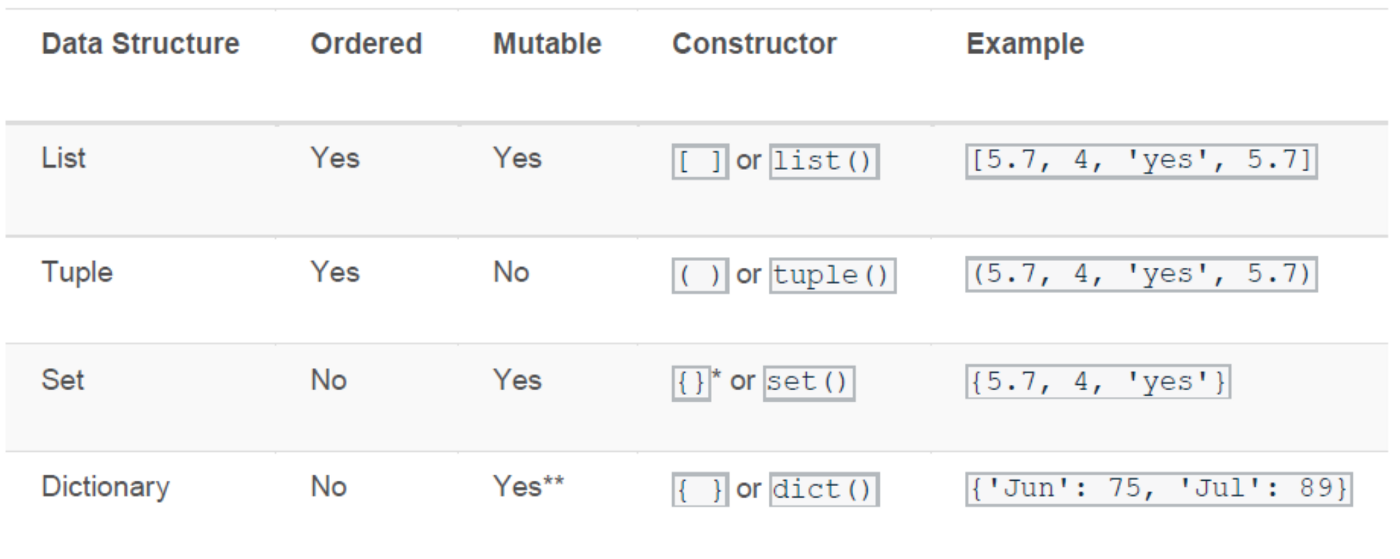
list.append(x) Add an item to the end of the list. Equivalent to a[len(a):] = [x].
list.extend(iterable) Extend the list by appending all the items from the iterable. Equivalent to a[len(a):] = iterable.
list.insert(i, x) Insert an item at a given position. The first argument is the index of the element before which to insert, so a.insert(0, x) inserts at the front of the list, and a.insert(len(a), x) is equivalent to a.append(x).
list.remove(x) Remove the first item from the list whose value is equal to x. It raises a ValueError if there is no such item.
list.pop([i]) Remove the item at the given position in the list, and return it. If no index is specified, a.pop() removes and returns the last item in the list. (The square brackets around the i in the method signature denote that the parameter is optional, not that you should type square brackets at that position. You will see this notation frequently in the Python Library Reference.)
list.clear() Remove all items from the list. Equivalent to del a[:].
list.index(x[, start[, end]]) Return zero-based index in the list of the first item whose value is equal to x. Raises a ValueError if there is no such item. The optional arguments start and end are interpreted as in the slice notation and are used to limit the search to a particular subsequence of the list. The returned index is computed relative to the beginning of the full sequence rather than the start argument.
list.count(x) Return the number of times x appears in the list.
list.sort(*, key=None, reverse=False) Sort the items of the list in place (the arguments can be used for sort customization, see sorted() for their explanation).
list.reverse() Reverse the elements of the list in place.
list.copy() Return a shallow copy of the list. Equivalent to a[:].
Tuple methods
tuple.count() Returns the number of times a specified value occurs in a tuple.
tuple.index() Searches the tuple for a specified value and returns the position of where it was found.
Set methods
set.add() Adds an element to the set.
set.clear() Removes all the elements from the set.
set.copy() Returns a copy of the set.
set.difference() Returns a set containing the difference between two or more sets.
set.difference_update() Removes the items in this set that are also included in another, specified set.
set.discard() Remove the specified item.
set.intersection() Returns a set, that is the intersection of two or more sets.
set.intersection_update() Removes the items in this set that are not present in other, specified set(s).
set.isdisjoint() Returns whether two sets have a intersection or not.
set.issubset() Returns whether another set contains this set or not.
set.issuperset() Returns whether this set contains another set or not.
set.pop() Removes an element from the set.
set.remove() Removes the specified element.
set.symmetric_difference() Returns a set with the symmetric differences of two sets.
set.symmetric_difference_update() Inserts the symmetric differences from this set and another.
set.union() Return a set containing the union of sets.
set.update() Update the set with another set, or any other iterable.
Dictionary methods
dict.clear() Removes all the elements from the dictionary.
dict.copy() Returns a copy of the dictionary.
dict.fromkeys() Returns a dictionary with the specified keys and value.
dict.get() Returns the value of the specified key.
dict.items() Returns a list containing a tuple for each key value pair.
dict.keys() Returns a list containing the dictionary’s keys.
dict.pop() Removes the element with the specified key.
dict.popitem() Removes the last inserted key-value pair.
dict.setdefault() Returns the value of the specified key. If the key does not exist: insert the key, with the specified value.
dict.update() Updates the dictionary with the specified key-value pairs.
dict.values() Returns a list of all the values in the dictionary.
The Business Analyst is an agent of change. Business Analysis is a disciplined approach for introducing and managing change to organizations, whether they are for-profit businesses, governments, or non-profits. It involves understanding and determining how organizations work so that their full potential can be realized.
The profession of Business Analysis is used to identify and articulate the need for change in how organizations work, and to facilitate that change. Business analysts identify and define the solutions that will maximize the value delivered by an organization to its stakeholders. They work across all levels of an organization and may be involved in everything including:
defining strategy.
creating the enterprise architecture.
taking on a leadership role by defining the goals and requirements for programs and projects.
supporting continuous improvement an organization’s technology and processes.
Gain the experience you need to work as a business analyst and any of the allied roles by joining the Business Analyst Experience Simulator adjacent. Job titles for business analysis practitioners include:
Business analysts have the specialized knowledge and skills to act as a guide and lead the business through unknown or unmapped territory, to get it to its desired destination. The value of business analysis is in realization of benefits, avoidance of cost, identification of new opportunities, understanding of required capabilities and modeling the organization. Through the effective use of business analysis, we can ensure an organization realizes these benefits, ultimately improving the way they do business.
Many other jobs, such as project management, product management, software development, quality assurance and interaction design rely heavily on business analysis skills for success.
The average base salary a Business Analyst makes in the United States ranges between $82,411 and $93,000. (Data: Indeed and BLS). The average additional cash compensation for a Business Analyst in US is $7,869. The average total compensation for a Business Analyst in US is $90,742. To know details of business analyst salaries in every state in the USA, read here.
Business analyst salaries in Canada
The average base salary a Business Analyst makes in the United States ranges between $84,998 and $146,184. (Data: Indeed and Talent). The average additional cash compensation for a Business Analyst in US is $7,869. The average total compensation for a Business Analyst in US is $72,676.
Frequently Asked Questions about Business Analysis Skills
What are some common roles that require business analysis skills?
Some common roles that require business analysis skills include: Business Analyst: This role specifically focuses on analyzing business processes, identifying business needs, and translating them into requirements for IT solutions or process improvements. Project Manager: Project managers often need business analysis skills to gather requirements, analyze business processes, and ensure that project deliverables align with business goals and objectives. Product Manager: Product managers use business analysis skills to understand customer needs, conduct market research, and develop strategies for creating and launching successful products. Systems Analyst: Systems analysts analyze and design IT systems to meet business requirements. Business analysis skills are crucial in understanding business needs and translating them into system specifications. Data Analyst: Data analysts use business analysis skills to analyze and interpret data, identify trends and patterns, and provide insights to drive decision-making and improve business processes. IT Consultant: IT consultants often require business analysis skills to understand client requirements, analyze existing business processes, and recommend IT solutions to meet their needs. Operations Manager: Operations managers use business analysis skills to analyze and optimize business processes, identify areas for improvement, and implement changes to increase efficiency and effectiveness. Quality Assurance Analyst: Quality assurance analysts use business analysis skills to understand business requirements, develop test plans, and ensure that software and systems meet business needs and quality standards. Change Management Specialist: Change management specialists analyze the impact of organizational changes, assess stakeholder needs, and develop strategies to effectively manage change within an organization. Entrepreneur/Small Business Owner: Entrepreneurs and small business owners need business analysis skills to identify market opportunities, analyze customer needs, and develop business strategies for success.
What are the key skills needed for roles that require business analysis skills?
The key skills needed for roles that require business analysis skills include: Requirements Elicitation and Management: The ability to effectively gather, document, and manage requirements from stakeholders to ensure that business needs are accurately captured and translated into actionable deliverables. Data Analysis: The ability to analyze and interpret data to identify patterns, trends, and insights that can drive decision-making and support business goals. Process Analysis and Improvement: The ability to analyze business processes, identify bottlenecks, inefficiencies, and areas for improvement, and develop strategies for optimizing processes to achieve better outcomes. Problem-Solving: The ability to identify and analyze business problems, develop solutions, and make recommendations to address challenges and improve business operations. Communication and Stakeholder Management: The ability to effectively communicate with stakeholders at various levels of the organization, understand their needs, and manage relationships to ensure that business requirements are met. Business Domain Knowledge: A deep understanding of the industry, domain, or sector in which the role operates, including knowledge of relevant regulations, market trends, and best practices. Technical Knowledge: Depending on the specific role, business analysis skills may require technical knowledge in areas such as software development, data management, or IT systems. Project Management: The ability to plan, organize, and manage projects, including defining project scope, developing timelines, and monitoring progress to ensure successful project delivery. Change Management: The ability to understand the impact of organizational changes, develop change management strategies, and effectively manage change to ensure smooth adoption within the organization. Collaboration: The ability to work effectively in a team environment, collaborate with cross-functional teams, and build consensus among stakeholders to achieve common goals.
What are some common tools and techniques used in business analysis?
Some common tools and techniques used in business analysis include: SWOT Analysis: A framework used to identify and analyze the strengths, weaknesses, opportunities, and threats of a business. Use Case Modeling: A technique used to capture and document functional requirements by describing how users interact with a system or solution. Process Mapping: A visual representation of business processes, used to analyze and optimize workflows, identify bottlenecks, and improve process efficiency. Data Flow Diagrams: Diagrams used to model the flow of data through a system, helping to identify data sources, transformations, and outputs. Business Process Modeling Notation (BPMN): A standard graphical notation used to model business processes, capturing the flow of activities, decisions, and interactions within a process. Stakeholder Analysis: A technique used to identify and analyze stakeholders, their roles, interests, and level of influence, in order to effectively manage stakeholder relationships. Requirements Documentation: Techniques such as creating requirement documents, user stories, use cases, and mockups to clearly define and document business requirements. Prototyping: Creating prototypes or mockups to visualize and validate business requirements and gather feedback from stakeholders. Interviewing and Facilitation: Techniques such as conducting interviews, workshops, and focus groups to gather information, clarify requirements, and facilitate discussions among stakeholders. Decision Analysis: Techniques such as decision trees, decision matrices, and prioritization methods to evaluate options and make informed decisions based on business goals and requirements.
How important are business analysis skills in today’s business environment?
Business analysis skills are highly important in today’s dynamic and competitive business environment. They play a critical role in enabling organizations to identify and address business problems, uncover opportunities for improvement, and make informed decisions based on data and analysis. Business analysis skills help organizations align their business strategies, processes, and IT solutions to meet business goals and customer needs. They also contribute to successful project management, effective stakeholder management, and efficient resource utilization. In today’s fast-paced business landscape, organizations need skilled business analysts who can analyze complex situations, provide insights, and drive business success through informed decision-making and efficient business processes.
What are the benefits of having business analysis skills in a role?
Having business analysis skills in a role can provide several benefits, including: Improved decision-making based on data and analysis. Better alignment of business strategies, processes, and solutions. Increased efficiency and effectiveness of business operations. Enhanced stakeholder management and communication. Greater ability to identify and address business problems and opportunities. Improved project outcomes through accurate requirements gathering and management. Enhanced ability to optimize business processes and drive continuous improvement. Increased ability to understand and meet customer needs. Better change management and adoption of organizational changes. Greater overall business success and competitiveness.
What industries or sectors commonly require business analysis skills?
Business analysis skills are applicable across various industries and sectors, including but not limited to: Information Technology (IT) and Software Development. Banking, Financial Services, and Insurance. Healthcare and Life Sciences. Retail and E-commerce. Manufacturing and Supply Chain. Consulting and Professional Services. Government and Public Sector. Energy and Utilities. Telecom and Communications. Non-profit and Social Enterprises.
Can business analysis skills be applied to small businesses?
Yes, business analysis skills can be applied to small businesses as well. Small businesses can benefit from effective business analysis in areas such as identifying customer needs, optimizing business processes, improving decision-making, and achieving operational efficiencies. Business analysis can help small businesses make informed decisions, align their strategies and operations, and drive growth and success in a competitive market.
Can business analysis skills be used in agile or iterative project management approaches?
Yes, business analysis skills can be effectively used in agile or iterative project management approaches. In fact, business analysts often play a crucial role in agile methodologies by gathering and managing requirements, analyzing and documenting user stories, facilitating communication among team members, and ensuring that solutions are aligned with business goals. Business analysis skills can help in prioritizing requirements, optimizing workflows, and delivering value to customers in agile or iterative project management approaches.
The Functional Requirements Document (FRD) is a formal statement of an application’s functional requirements. When clearly defined, requirements lead to successful project outcomes. Approved requirements establish an agreement between the customer (internal or external) and a provider to reach the same goal. In this article, we explain the need for a functional requirements document, its structure, contents, and offer a sample template format for your work.
What is a Functional Requirements Document (FRD)?
An FRD or Functional Requirements Document serves as a contract for formal statement, between the business stakeholders and the technology team, on an application’s functional requirements. The FRD is produced by business analysts or sometimes the technical team in response to the business requirements (captured in a BRD – Business Requirements Document).
The key purpose of an FRD is to translate business needs into technological functions in a system. It’s where project stakeholders and the technical development team meet. The creation of the FRD facilitates and ensures collaboration between business and technical stakeholders:
Business– it restates the business requirements in terms of functional features and capabilities to be supported by the new system or platform. This ensures the project team understands the business requirements and are on their way to implement a solution which addresses the business needs or problems.
Technology– it captures key technical constraints and commitments as well key interfaces to external systems
While created by the solution team comprising business analysts, the FRD should be solution independent (in general) and it should express what the application should do and not how it should do it. The FRD should not commit the technical team to a specific design. It is for the technical team to develop the actual design and implementation tactics.
The Functional Requirements Document (FRD) is one of the most popular ways to express functional specifications and define the requirements and functional solutions.
Functional Requirements Document FRD Template
Click the button to download the example FRD template format for your work.
The Business Analysis Body of Knowledge (BABOK) acknowledges requirements as a usable representation of a need. Unambiguous, and detailed requirements help reduce cost and schedule risks and keeps the project on track.
Examples of functional requirements:
The following are some uncategorized examples of software requirements:
The system should have the capability to store and retrieve employee information.
A dashboard should be made available on demand with charts and tables (details to follow) depicting organizational statuses in real time.
The system should integrate with AWS SageMaker endpoints to retrieve predictions made on user input data for loan categorization.
All user interfaces should load in under 3 seconds, even under a load of 100 concurrent users.
Website traffic to and from the server should be secured using a 256-bit SSL.
The need for a functional requirements document
While the list of requirements above may suffice on smaller projects, large software development needs a more steady and structured approach. The FRD is a derivative and expanded version of the business requirement document BRD.
Functional requirements capture the intended behavior of the system and hence are tailored to fit the project’s need. This behavior may be expressed as services, tasks or functions the system is required to perform. The functional requirements are designed for the readership of a general audience to understand the system. Business as well as technical stakeholders should comprehend the same details in the FRD. Hence, no technical knowledge is required to understand this document.
The Functional Requirements Document (FRD) serves the following purpose:
Demonstrates that the application provides value in terms of the business objectives and business processes.
Contains a complete set of requirements for the application. It leaves no room for anyone to assume anything which is not stated in the FRD.
Is solution independent. The FRD is a statement of what the application is to do. The FRD does not instruct designs or implementation details to the technical team. Hence, references to the use of a specific technology is entirely inappropriate in an FRD. Technical implementation details are confined to a Technical Specification (TS) or the Software Requirements Specification (SRS).
Functional Requirements Document FRD Template
Click the button to download the example FRD template format for your work.
Both functional and nonfunctional requirements can be formalized in the Functional Requirements Document. FRD / FRS’s contain descriptions of features, functions and abilities that the software product must provide. The document also defines constraints and assumptions. These can be a single document communicating functional requirements or it may accompany other software documentation like user stories and use cases.
The FRD is created for the entire solution or a part of it, and is usually an iterative process of consultations with business and technical stakeholders. Every feature must be documented before actually developing it. It is not uncommon for the FRD to undergo a series of revisions as the product is developed over multiple releases. This is because as newer information and client feedback is received, the development team gains greater clarity of the objectives. Everyone understands the importance of features, which can be accordingly prioritized.
Sections
The FRD / FRS includes all or part of the following sections:
Introduction 1.1 Purpose of Document 1.2 Project Summary 1.3 Background 1.4 Project Scope 1.5 System Purpose 1.5.1 Users 1.5.2 Location 1.5.3 Responsibilities 1.5.4 Need 1.6 Overview of Document
Functional Objectives 2.1 High Priority 2.2 Medium Priority 2.3 Low Priority
Non-Functional Objectives 3.1 Reliability 3.2 Usability 3.3 Performance 3.4 Security 3.5 Supportability 3.6 Online user Documentation and Help 3.7 Purchased Components 3.8 Interfaces
The Context Model 4.1 Goal Statement 4.2 Context Diagram 4.3 System Externals
The Use Case Model 5.1 System Use Case Diagram 5.2 Use Case Descriptions (for selected cases)
User Stories
Appendix Glossary
This list of sections is meant to be representative and a guide, not a hard and fast rule. Every project is different, and you will need to determine the level of detail required for your FRD. For free support with your FRD, use the chat box to chat with our support team or send an email to support@savioglobal.com.
Excel as a Business Analyst by experiencing all aspects of the role first hand
Use cases describe the interaction between the system and external users that leads to achieving particular goals.
Each use case includes three main elements:
Actors: These are the external users that interact with the system.
System: The system is described as functional requirements that define an intended behavior of the product.
Goals: The purposes of the interaction between the users and the system are outlined as goals.
There are two formats to represent use cases:
Use case description
Use case model (diagram)
A use case specification represents the sequence of events along with other information that relates to this use case. A typical use case specification template includes the following information:
Use Case Name
Summary
Basic Flow
Alternative Flows
Extension Points
Preconditions
Postconditions
Business Rules
Use case description example and template
A use case diagram doesn’t contain a lot of details. It shows a high-level overview of the relationships between actors, different use cases, and the system.
The use case diagram includes the following main elements:
Use cases. Usually drawn with ovals, use cases represent different interaction scenarios that actors might have with the system (log in, make a purchase, view items, etc.).
System boundaries. Boundaries are outlined as boxes that groups various use cases in a system.
Actors. These are the figures that depict external users (people or systems) that interact with the system.
Associations. Associations are drawn with lines showing different types of relationships between actors and use cases.
The Agile Alliance describes user stories as work that is divided up into functional increments. User stories are developed and represented in a format that emphasizes the value to the end user of the system. A typical user story describes three components:
The end goal for the user to use the system. This is the most important factor when it comes to developing functional requirements. Always begin with the end in mind; the value being delivered to the user. For example, the ability to order products (ecommerce like Amazon), track deliveries (ecommerce like Flipkart, Alibaba), enjoy relevant content (streaming like Netflix, Spotify, Zee or social media like Instagram, TikTok), interact with people (messaging or social media apps like Twitter, Facebook, Whatsapp), etc.
The action that the user intends to perform, which when performed will lead to the goals being achieved (point #1). For example, placing an order, making payments, reviewing products, navigating pages, etc.
The user role or type of user. For example, user roles may be customers, prospects, administrative users, etc.
Format of a user story
User stories are modelled on the following lines:
As a (role) I want to do (something) so that I can (benefit).
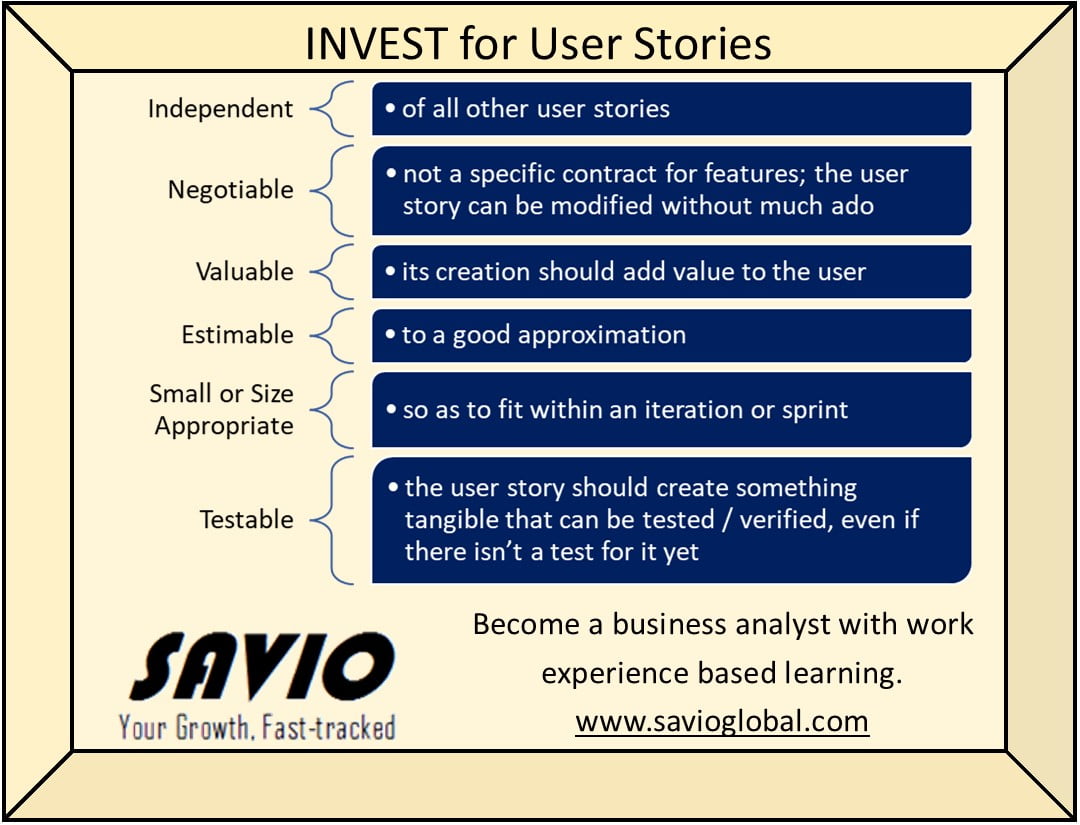
INVEST in a good user story
INVEST in an acronym that serves as a guideline for us to generate clear and useful user stories, and functional requirements in general.
The INVEST for a good user story stands for:
“I” – Independent (of all other user stories)
“N” – Negotiable (not a specific contract for features; the user story can be modified without much ado)
“V” – Valuable (its creation should add value to the user)
“E” – Estimable (to a good approximation)
“S” – Small or Size Appropriate (so as to fit within an iteration or sprint)
“T” – Testable (the user story should create something tangible that can be tested / verified, even if there isn’t a test for it yet)
The INVEST checklist for evaluating user stories originated in Bill Wake’s 2003 article, which also utilized acronym SMART (Specific, Measurable, Achievable, Relevant, Time-boxed) for deliverables resulting from the decomposition of user stories.
The INVEST acronym was one among the techniques recommended in Mike Cohn’s “User Stories applied“, which discusses the concept at length in Chapter 2.
What does INVEST for good user stories stand for?
Difference between functional and nonfunctional requirements
Functional requirements are product features or functions that developers must implement to enable users to accomplish their tasks. So, it’s important to make them clear both for the development team and the stakeholders. Generally, functional requirements describe system behavior under specific conditions. For example, the system should:
Authentic a user login attempt after the user enters personal information.
Feature a search box which allows users to discover products related to their search inputs among various products on the platform.
Send a order confirmation email when a new order is placed upon successful payment.
Non-functional requirements in an FRD
Nonfunctional requirements define how the system should perform. Some examples are:
The website pages should load in 3 seconds with up to 1000 concurrent users.
The system should be able to handle 1 million users in a month without performance deterioration.
Here’s a brief comparison and then we’ll proceed to a more in-depth explanation of each group.
Parameter
Functional requirements
Nonfunctional requirements
Objective
Describe what the product does
Describe how the product works
End result
Define product features
Define product properties
Focus
User requirements
User expectations
Documentation
Captured in use case
Captured as a quality attribute
Essentiality
They are mandatory
They are not mandatory, but desirable
Origin type
Usually user defined
Usually developer defined or other tech experts
Testing Precedence
Tested before nonfunctional testing
Tested after functional testing.
Examples
– User interface, – authentication, – authorization levels, – business rules, etc.
– Performance, – usability, – security – testing, etc.
Functional Requirements Document FRD Template
Click the button to download the example FRD template format for your work.
Nonfunctional requirements describe how a system must behave and establish constraints of its functionality. The following are the most typical nonfunctional requirements utilized in most functional requirements documents FRD.
Usability
Usability defines how difficult it will be for a user to learn and operate the system. Here’s how usability can be evaluated:
Efficiency of use: the average time it takes to accomplish a user’s goals, how many tasks a user can complete without any help, the number of transactions completed without errors, etc.
Intuitiveness: how simple it is to understand the interface, buttons, headings, etc.
Low perceived workload: how many attempts users need to accomplish a particular task.
Example: Usability requirements can consider language barriers and localization tasks: People with no understanding of French must be able to use the product. Or you may set accessibility requirements: Keyboard users who navigate a website using <tab>, must be able to reach the “Add to cart” button from a product page within 15 <tab> clicks.
Security
Security requirements ensure that the software is protected from unauthorized access to the system and its stored data. It considers different levels of authorization and authentication across different users roles. For instance, data privacy is a security characteristic that describes who can create, see, copy, change, or delete information. Security also includes protection against viruses and malware attacks.
Example: Access permissions for the particular system information may only be changed by the system’s data administrator.
Reliability
Reliability defines how likely it is for the software to work without failure for a given period of time. It decreases because of bugs in the code, hardware failures, or problems with other system components. To measure software reliability, you can count the percentage of operations that are completed correctly or track the average period of time the system runs before failing.
Example: The database update process must roll back all related updates when any update fails.
Performance
Performance is a quality attribute that describes the responsiveness of the system to various user interactions with it. Poor performance leads to negative user experience. It also jeopardizes system safety when it’s overloaded.
Example: The front-page load time must be no more than 2 seconds for users that access the website using an LTE mobile connection.
Availability
Availability is gauged in terms of time that the system’s functionality and services are available for use with all operations. So, scheduled maintenance periods directly influence this parameter. And it’s important to define how the impact of maintenance can be minimized. When writing the availability requirements, the team has to define the most critical components of the system that must be available at all times. You should also prepare user notifications in case the system or one of its parts becomes unavailable.
Example: New module deployment mustn’t impact front page, product pages, and check out pages availability and mustn’t take longer than one hour. The rest of the pages that may experience problems must display a notification with a timer showing when the system is going to be up again.
Scalability
Scalability requirements describe how the system must grow without negative influence on its performance. This means serving more users, processing more data, and doing more transactions. Scalability has both hardware and software implications. For instance, you can add memory, servers, or disk space to increase scalability. On the other hand, you can compress data, use optimizing algorithms, etc.
Example: The website attendance limit must be scalable enough to support 200,000 users at a time.
Functional Requirements Document FRD Template
Click the button to download the example FRD template format for your work.
Prototypes are meant to be inexpensive and quickly developed visual representations of requirements. Wireframes are low-detail illustrations of a website or an app. To break it down, wireframes are low-fidelity, basic layout and structural guidelines of your web product’s layout and prototypes are an advanced wireframe with more visual detail and interaction.
Wireframes serve as the foundation of a website or app’s visual layout, and it is at this stage that you will arrange elements on the page or screen. The purpose is to map out the priority of the content on the screen. A good rule of thumb is to keep your wireframes simple, with details that represent the core structure of your site / app only.
Best practices while creating the functional requirements document FRD
Creating documentation is an integral part of any software development project. Well-documented requirements ensure that stakeholders and developers are on the same page and also help define project scope and budget. Here are a few useful tips on how to make great documentation.
Requirements have to be clear and understandable. Make sure your requirements are stated in a concise manner that doesn’t contain ambiguity or allow different interpretations. Also, try to avoid technological jargon. Remember that each audience is different and stakeholders might not be familiar with specialized tech terminology. Instead, enrich your documents with visuals, diagrams, and graphs to support the information and make it easier to perceive. Adding glossaries and cross-links is also helpful.
Requirements have to bespecific, accurate, and complete. When writing your documentation, be consistent with the language and make sure that your requirements are accurate. They should cover every scenario, but never contradict each other. Avoid vagueness and weak phrases such as “system has to be fast” or “when something happens.” Be specific and quantify the terms so that all the readers can understand them in the same way.
Requirements have to betestable. Write requirements in such a way that after the product is created, testing can show whether they are delivered successfully. The FRD is frequently used as a bases for user acceptance test case development and testing.
Requirements have to befeasible and sensible. Focus on the functionality and quality attributes that users actually need. Remember that requirements have to reflect higher-level business objectives.
Gain real and complete experience as a business analyst. Join the Business Analyst Work Experience Program
Frequently Asked Questions about the Functional Requirements Documents (FRD)
Who creates the functional requirements documents (FRD)?
The business analyst (BA) usually is the one who creates the FRD. The BA is best suited to propose a functional solution because of their deep understanding of the domain and the business needs.
When is the functional requirements documents (FRD) created?
The development of the functional requirements document (FRD) generally occurs after the finalization of the business requirements in the form of the BRD.
What is the use of the functional requirements documents (FRD) for downstream processes?
The FRD serves as a basis for all subsequent project development activities including the development of detailed system designs, technical specifications, and SIT and UAT test cases.
How can the functional requirements documents (FRD) be used in software testing?
The development of test cases primarily relies on the FRD as the best source of information. This is applicable for system integration testing (SIT) and user acceptance testing (UAT). Expected behaviors of the system, along with impact implications are derived from the FRD.
Workforce readiness can be defined as having new workplace entrants prepared to enter the workforce with the requisite knowledge, skills, abilities and attributes in order to engage in endeavors that will be required in their respective occupations. Partnerships and alliances between educational institutions, governmental entities and employers can assist in ensuring that these new workforce entrants are sufficiently prepared to meet the challenges and opportunities they will face in the workplace.
Workforce Training/Education is defined as:
postsecondary activities (seminar, workshop, course, customized training, etc.) that develop or enhance the skills of existing employees or members of any business or industry.
training provided to individuals, whether employed or unemployed, that is designed to meet the employment needs of the student and/or employer
training that enhances occupational, technical, and/or soft skills (communication, computational, and interpersonal).
Workforce readiness / job readiness purpose
A workforce ready person capitalizes on personal strengths, talents, education and experiences to bring value to the workplace and the community through his/her performance, skill, diligence, ethics and responsible behavior.
When students are workforce ready, they are prepared for the next step in their lives—whether that means getting their first job or beginning their college (which eventually leads to the workplace as well)! Being workforce ready also means being ready for life.
Workforce ready refers to employment opportunities with meaningful opportunities for advancement as well as career training programs that offer technical certification or other marketable skills. Evidence and experiences indicate that the knowledge and skills needed to succeed in the workforce need some form of postsecondary training to succeed during their careers.
The Oregon Investment Education Board reports that having one definition for both terms “helps to break down the ‘silos’ in which education and workforce sectors often operate,” adding “significant research has shown that although the knowledge, skills, and applications of learning required for success in particular fields and programs of study vary, the overarching skills and strategies required for students of all ages entering colleges and careers are consistent” (Oregon Investment Education Board, 2014).
Explore our Workforce Development and Readiness Programs
Our simulated work experience programs are completely driven with experiential learning. Experiential learning (ExL) is the process of learning through experience, and is more narrowly defined as “learning through reflection on doing”. Experiential learning is distinct from rote or didactic learning, in which the learner plays a comparatively passive role. We combine and enhance experiential learning with other higher order forms of active learning such as:
cooperative learning,
service-learning,
situation-based learning
Workforce job ready skills
Employers are increasingly considering competencies — rather than degrees — as the most important factor in hiring, according to a new report from the U.S. Chamber of Commerce Foundation.
Companies have forever needed workforce ready individuals; people with the necessary skills to get started from day-1. While a variety of factors are involved in development of an individual’s skills, such as upbringing, networks, and quality of education, these usually do not restrict the individual’s ability to continuously grow and develop newer or enhanced skills.
At Savio Education Global, we work to instill these necessary skills that ensure people are ready for the workforce. We achieve this through our proprietary simulated work experience programs.
Explanation of workforce ready skills
Analytical Inquiry/Reasoning = The capacity to recognize, describe and effectively solve problems through differentiation, categorization and other tools of inquiry and reasoning.
Computational Thinking = The power to translate data into concepts and to derive data-based reasoning.
Computer Literacy = The potential to use computers and related technology efficiently and productively.
Cross-Cultural Competency = The ability to operate and engage in diverse cultural setting.
Emotional/Social Intelligence = The means to connect to others in a deep and direct way, to sense and stimulate reactions and desired interactions.
Ethical Reasoning = The judicious and self-reflective application of ethical principles and professional or occupational codes of conduct to making decisions, taking action, and resolving issues.
Information Literacy = The capability to know how to find, organize and evaluate information through independent or collaborative inquiry in order to work with and contribute to it.
Language Proficiency = The abilityto speak, read, write and comprehend a language.
New Media Literacy = The power to critically assess and develop content that uses new media forms and to leverage these media for persuasive communication.
Novel/Adaptive Thinking = Proficiency at creative thinking and coming up with solutions and responses beyond that which is rote or rule-based.
Persuasive Speaking = The ability to articulate, to engage audiences, and to present messages effectively.
Quantitative Fluency = The ability to understand and use essential arithmetic skills, calculations and symbolic operations to construct, support and visualize valid arguments.
Teamwork-Collaboration = The skill to work productively, drive engagement, negotiate a strategy for group research or performance, and effectively communicate results as a member of a team.
Transdisciplinary = Literacy in and ability to understand concepts and complex problems across multiple disciplines.
Written Communication = The ability to write effective and coherent explanations and arguments for multiple types of audiences with attention to the implications of language.
Integrate workforce development and readiness programs with college curriculums at the bachelors and the masters levels
You’ve crafted an awesome curriculum. That’s great and its one of the ways we deliver education viz. subject / topic based. Now compliment your strategy with experience based education to make your students unstoppable! Studies have shown that work based education tend to help summarize, assimilate, and actuate learnings, in addition to generating new insight, and muscle memory of the work performed.
Companies increasingly demand job specific skills which topic based education may not comprehensively fulfill. Hence, choose our Work Experience Program, which is the world’s first work based learning program for managerial and technical roles to make your students job ready.
Our program is effective because our educators and analysts create a simulated work environment for every participant, placing them in these specific job roles that, actuating them to perform the role to the best extent possible. At the end of the program, participant see for themselves, how their new found skills perfectly align with job descriptions that companies float!
Frequently asked questions about workforce readiness and development programs
What is the meaning of work readiness program?
A work readiness program refers to a structured set of initiatives aimed at equipping individuals, often students or job seekers, with the essential knowledge, skills, and attributes necessary to effectively engage in the demands and responsibilities of the workforce, ensuring they are prepared for employment or further education.
What is the importance of workforce readiness?
Workforce readiness is crucial as it ensures that individuals possess the required capabilities to excel in their chosen occupations or fields. It helps bridge the gap between academic knowledge and practical application, enabling smoother transitions into employment or higher education.
What is the meaning of workforce ready?
Being workforce ready means having the requisite skills, abilities, and attributes to perform effectively in a professional environment. It involves capitalizing on personal strengths, education, and experiences to contribute value to the workplace through skills, ethics, diligence, and responsible behavior.
What is an example of workforce development?
An example of workforce development is the collaboration between a local university and a manufacturing company to establish training programs that teach specialized technical skills, ensuring that students are equipped to fill specific roles within the company upon graduation.
What are the readiness activities?
Readiness activities encompass a range of initiatives designed to prepare individuals for employment or advanced education, such as workshops, seminars, courses, and training programs that enhance technical and soft skills relevant to various occupations.
What are the objectives of workforce development?
The objectives of workforce development include facilitating the acquisition of job-specific skills, improving employability, addressing labor market needs, fostering economic growth, and promoting continuous learning to adapt to changing industry demands.
What is an example of workforce development?
A regional economic development agency partnering with local businesses to offer apprenticeship programs in trades like plumbing and electrical work, which provide hands-on training and experience while addressing workforce shortages.
What is the goal of the workforce development?
The goal of workforce development is to enhance the capacity and skills of individuals to meet the demands of the labor market effectively, thereby contributing to economic growth, job creation, and improved career prospects.
What is workforce development platform?
A workforce development platform refers to an integrated system or framework that combines educational institutions, government entities, employers, and training providers to offer a range of resources, programs, and initiatives aimed at preparing individuals for successful entry into the workforce.
Simulated work based learning (WBL) gives students the experience of traditional work-based learning, but without leaving the campus / home. The purpose of simulated work-based learning is to provide workplace opportunities for students seeking to hone their skills in a desired role, even while being ineligible to work.
Advantages of Work Based Learning
Our Business Analyst Experiences is a simulated WBL and provides several advantages to institutes who offer and desire experiential learning opportunities for their pupil, including:
Work that places students in multi-national corporation style experiences.
Significant work tenure of around 8 weeks, which can substitute an internship.
Practical deliverable oriented experiences that mandates the creation of business documents and results.
Filled with short-duration advanced training to raise student skills to practitioner levels.
Can be paired with a curriculum course to run parallelly.
Encourages team based performance, dependence, and interactions; wherein student inputs dictate the results generated.
Hones written communication skills with team members, the ability to write clearly, concisely and to the point.
Here we recommend the top 5 tools and technologies for business analysis that you should master. In increasing order of technical ability:
Tools and Technologies for Business Analysis
MS Excel of the MS Office suite: Let’s face it. A majority of us who have worked a job in the past 10 years have definitely (at least) heard of MS Excel. It’s simple sandbox styled interface, a plethora of features, functions, and easy to understand layout have made it an indispensable tool for many. Statistical modelling and analysis can be easily achieved by the using the Data Analysis Toolpak. And complex optimization scenarios can be explored and achieved with the Solver add-in.
MS Visio or yEd: A BA is frequently required to represent the current state and future state of organizational processes or programmatic workflows. This is accomplished through the use of a framework called the business process modelling notation. It is a set of guidelines that help creating notations that are easily understood and interpreted by people in the same field. MS Visio or yEd are commonly used tools and technologies for this purpose.
Tableau: The Tableau Software has seen tremendous growth over recent years. This is thanks in part to the thrust to infuse analytics in business intelligence. This growth is also due to the fact that it is one of the easiest tools to master visualization. Tableau’s features truly surpass many of its competitors. And its no surprise that companies are increasingly dependent on Tableau Software products for their business intelligence and visual analytics needs.
While some roles do not expect programming from business analysts, it is increasingly evident from current job profiles and company expectations that some form of programming experience is desired, and preferably the ones discussed below.
Structured Query Language (SQL): SQL is a programming language used specifically to interact with relational databases. There are several flavours of SQL with every relational database vendor attempting to create a unique or stylized version of it for their systems. Think of MS SQL Server, Oracle’s PLSQL, MySQL (acquired by Oracle, etc.). But the core abilities and language constructs – syntax (think of grammar) remain the same across databases. A BA is frequently required to interact with data and databases for their work. This is truer for business analysts in technologically intensive industries.
Join our Business Analyst Experience Simulator to gain the skills you need, be evaluated, and excel as a business analyst! Know more.
Only at – Savio Global
Python programming: While many companies depend on Python programmers to build websites, apps, and other technologies, a BA also would do well to learn this language. Companies increasingly rely on statistical models for decision making. Python has a huge collection of community driven packages that make even complex algorithms available for your use with a few lines of code. Don’t be afraid; Python is also one of the easiest languages you could learn. It’s meant to be English-like. So if you’re reading this article, you probably can also learn Python quickly!
We use cookies to make our website a better place. Cookies help to provide a more personalized experience and web analytics. To learn more about the different cookies we're using, check out our Cookie Policy (baked goods not included). Read More
This website uses cookies to improve your experience while you navigate through the website. Out of these, the cookies that are categorized as necessary are stored on your browser as they are essential for the working of basic functionalities of the website. We also use third-party cookies that help us analyze and understand how you use this website. These cookies will be stored in your browser only with your consent. You also have the option to opt-out of these cookies. But opting out of some of these cookies may affect your browsing experience.
Necessary cookies are absolutely essential for the website to function properly. These cookies ensure basic functionalities and security features of the website, anonymously.
Cookie
Duration
Description
cookielawinfo-checkbox-analytics
11 months
This cookie is set by GDPR Cookie Consent plugin. The cookie is used to store the user consent for the cookies in the category "Analytics".
cookielawinfo-checkbox-functional
11 months
The cookie is set by GDPR cookie consent to record the user consent for the cookies in the category "Functional".
cookielawinfo-checkbox-necessary
11 months
This cookie is set by GDPR Cookie Consent plugin. The cookies is used to store the user consent for the cookies in the category "Necessary".
cookielawinfo-checkbox-others
11 months
This cookie is set by GDPR Cookie Consent plugin. The cookie is used to store the user consent for the cookies in the category "Other.
cookielawinfo-checkbox-performance
11 months
This cookie is set by GDPR Cookie Consent plugin. The cookie is used to store the user consent for the cookies in the category "Performance".
viewed_cookie_policy
11 months
The cookie is set by the GDPR Cookie Consent plugin and is used to store whether or not user has consented to the use of cookies. It does not store any personal data.
Functional cookies help to perform certain functionalities like sharing the content of the website on social media platforms, collect feedbacks, and other third-party features.
Performance cookies are used to understand and analyze the key performance indexes of the website which helps in delivering a better user experience for the visitors.
Analytical cookies are used to understand how visitors interact with the website. These cookies help provide information on metrics the number of visitors, bounce rate, traffic source, etc.
Cookie
Duration
Description
_ga
2 years
This cookie is installed by Google Analytics. The cookie is used to calculate visitor, session, campaign data and keep track of site usage for the site's analytics report. The cookies store information anonymously and assign a randomly generated number to identify unique visitors.
_ga_WLK0SPBG2G
2 years
This cookie is installed by Google Analytics. The cookie is used to calculate visitor, session, campaign data and keep track of site usage for the site's analytics report. The cookies store information anonymously and assign a randomly generated number to identify unique visitors.
Advertisement cookies are used to provide visitors with relevant ads and marketing campaigns. These cookies track visitors across websites and collect information to provide customized ads.

 Business Analyst Work Experience Certification Course ProgramProduct on sale₹39,999


 The Project Management Institute observes that the
  The career of a business analyst involves developing several documents critical the the business objective including but not limited to
  The best way to gain experience as a business analyst is to enroll in a work based learning program like the one we have. Our
  Showcase your skills in business analysis by being certified in the